 Login
Login




Recent developments in Lithuania and Sweden have brought the discussion of the 700 MHz spectrum for public protection and disaster relief (PPDR) back into focus.
Both countries had previously reserved one third of the 2×30 MHz frequencies in the 700 MHz mobile allocation, effectively setting aside 2×10 MHz for potential future PPDR use. Yet their recent decisions point in different directions. Lithuania released its reserved spectrum to commercial operators, while Sweden is advancing plans that could make the reservation part of the future replacement for the Rakel public safety network.
These contrasting developments show that Europe still lacks a single approach to next-generation critical communications.
However, the more interesting question may not be how countries use spectrum reservations but how they plan to build and operate the next generation of mission-critical communications networks.
From broadcasting to broadband
Today's discussion has roots going back more than a decade.
As demand for mobile broadband continued to grow, Europe undertook a major spectrum reallocation, shifting the 700 MHz band from its historical use for digital terrestrial television to mobile broadband services. This culminated in the European harmonization framework established in 2016, which designated a harmonized 2×30 MHz allocation for Mobile/Fixed Communications Networks (MFCN).
In addition to the harmonized MFCN allocation, the framework identified two optional spectrum blocks adjacent to the commercial band that national administrations could designate based on national requirements:
- a lower 2×5 MHz block for PPDR or Program Making and Special Events (PMSE);
- an upper 2×3 MHz block for PPDR or Machine-to-Machine (M2M) communications;
- an additional 1×20 MHz supplemental downlink option for downlink-only communication in the so-called duplex gap between the uplink and downlink frequencies.
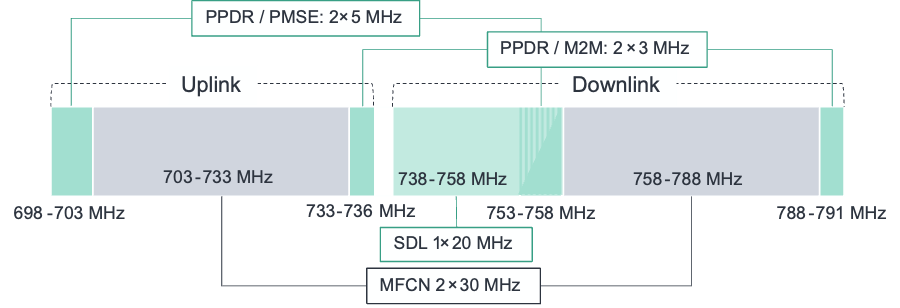
The framework therefore recognized from the outset that not all countries would necessarily adopt identical approaches to public safety communications.
At the time, the industry widely expected that LTE, and later 5G, would eventually replace legacy mission-critical technologies such as TETRA. Many anticipated that dedicated broadband PPDR networks would gradually emerge across Europe, supported either by reserved portions of the harmonized mobile allocation or by the adjacent national option blocks.
Ten years later, the deployment landscape appears far more diverse than many anticipated.
Different countries, different paths
The original vision of a straightforward migration from narrowband public-safety systems to dedicated nationwide broadband PPDR networks has proved more complicated in practice.
Some countries continue to pursue dedicated public-safety broadband infrastructure. The primary driver is often control. For certain governments and public-safety authorities, ownership or direct control of critical communications capabilities provides assurance that coverage, resilience, security, operational priorities, and future evolution remain aligned with national requirements rather than with commercial considerations.
Sweden is advancing plans for a future broadband successor to Rakel, with the reserved 700 MHz spectrum part of the discussion. Hungary has already gone significantly further, deploying an advanced, dedicated broadband PPDR network through the state-owned operator Pro-M. The network was designed for mission-critical communications and supports modern 4G and 5G services while supporting the migration away from narrowband technologies.
Other countries have adopted various implementation models.
Finland's Virve 2 program shows how broadband mission-critical services can be delivered through a combination of dedicated service operations and commercially provided radio infrastructure. State-owned Erillisverkot remains responsible for the service, while Elisa's nationwide commercial network provides mobile connectivity. During the transition, the legacy TETRA-based Virve network and broadband Virve 2 services coexist, allowing authorities to gradually introduce new broadband capabilities while maintaining proven mission-critical communications.
Similarly, the United Kingdom's Emergency Services Network (ESN) builds on commercial mobile infrastructure and adds the coverage, resilience, priority handling, and mission-critical capabilities required by emergency services.
Not all developments have prioritized public safety.
The flexibility envisioned by the original European framework is evident in Slovenia, where the upper 2×3 MHz national option block was assigned to business-critical and machine-to-machine communications rather than to broadband public safety services. This shows that demand for these spectrum resources has evolved differently across countries and sectors.
Taken together, these examples suggest that Europe is not converging on a single implementation model. Instead, a variety of approaches are emerging, reflecting different national priorities, operational requirements, and economic realities.
Why has large-scale broadband PPDR deployment been slower than expected?
The answer is not difficult to understand.
Building and operating a nationwide mobile network is a substantial undertaking. Beyond radio sites, operators must manage transmission infrastructure, core platforms, cybersecurity, resilience, network operations, lifecycle management, and specialist expertise over periods measured in decades.
At the same time, commercial mobile networks have evolved dramatically. Modern 4G and 5G networks offer extensive coverage, high reliability, and increasingly mature support for mission-critical features such as priority handling, preemption, mission-critical push-to-talk voice, and network slicing.
As a result, many authorities have concluded that the question is no longer whether broadband PPDR should exist, but rather how it should be delivered.
Some countries prioritize direct control of critical communications infrastructure and therefore value dedicated networks. Others seek to leverage commercial investments wherever practical while introducing the safeguards and capabilities required for mission-critical use. Many appear to be finding solutions somewhere between these two extremes.
The result is a much broader range of deployment models than was perhaps anticipated when Europe established its 700 MHz framework a decade ago.
The real challenge may now be migration
Legacy TETRA networks will not last forever.
Many continue to deliver exceptionally reliable mission-critical voice services today, but they represent a technology generation that is gradually approaching the latter stages of its lifecycle. Public safety authorities must therefore begin planning for what comes next, regardless of the implementation model they ultimately choose.
Replacing TETRA, however, is not merely a network upgrade.
Broadband platforms must demonstrate equivalent levels of coverage, resilience, availability, security, and operational reliability before they can fully assume the responsibilities currently handled by narrowband systems. Devices, operational procedures, applications, and user organizations must also mature alongside the technology.
This cannot happen overnight.
Programs such as Finland's Virve 2 demonstrate that coexistence between legacy and next-generation systems may be required for many years while broadband capabilities are proven in operational use. Similar migration approaches are emerging elsewhere as authorities seek to minimize operational risk while introducing the benefits of broadband communications.
The most important question facing the industry may no longer be spectrum allocation alone. Rather, it is how to manage a safe and effective transition from well-proven narrowband networks to broadband platforms capable of handling the full burden of mission-critical communications.
Europe's experience increasingly suggests that no single successor model is likely. Dedicated broadband PPDR networks are emerging in some countries, while others are building on commercial infrastructure. Some combine dedicated operational control with commercially provided radio access. The future may therefore be characterized less by technological convergence than by a diversity of implementation models.
Regardless of the model chosen, one reality remains unchanged: critical communications networks are measured in decades, not years. The decisions made today will determine the resilience, security, and effectiveness of public safety communications into the 2030s and beyond.
Reply a Comment